
How Many Balusters Do I Need? Spacing Calculator and Code-Compliant Quantities
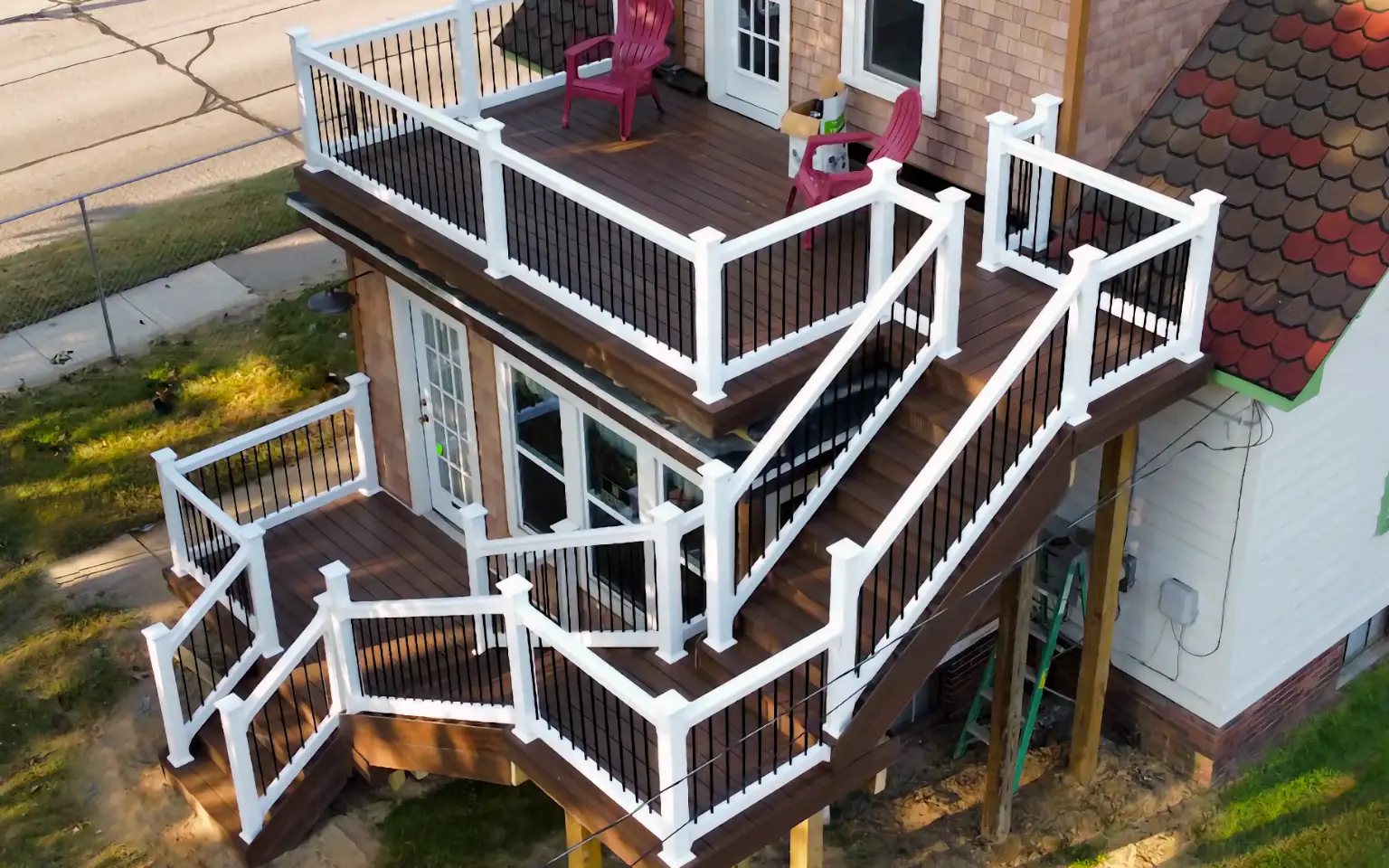
Getting the baluster count right before you order saves time, money, and a second trip to the supplier. Too few and you’re waiting on a reorder. Too many and you’ve got inventory sitting in the truck. Since The Deck Barn sells aluminum balusters by the piece, you can order the exact quantity — but you need to know the number first.
Here’s how to calculate it, plus a ready-to-use reference table for common railing lengths.
The Code Requirement
The International Residential Code (IRC) Section R312.1.3 states that the opening between balusters shall not allow passage of a 4-inch sphere. This means the clear gap between any two adjacent balusters cannot exceed 3-15/16″ (just under 4 inches).
Most builders target a clear gap of 3.5″ to 3.75″ to stay comfortably within code while keeping a consistent, clean look.
The Formula
For standard 3/4″ aluminum balusters with a target gap of 3.5″:
- Calculate on-center spacing: Baluster width (0.75″) + desired gap (3.5″) = 4.25″ on-center
- Divide rail opening by on-center spacing: Rail length ÷ 4.25 = approximate number of spaces
- Number of balusters = number of spaces – 1 (the posts create the first and last boundary)
- Round up to the nearest whole number
- Recalculate exact gap: (Rail length – (balusters × 0.75″)) ÷ (balusters + 1) = actual gap
Important: The gap between the post face and the first (and last) baluster also counts and must be under 4″. Include this in your layout.
Quick Reference Table
For 3/4″ aluminum balusters with approximately 3.5″ clear spacing:
| Rail Length | Balusters Needed | Connectors Needed | Actual Gap |
|---|---|---|---|
| 3 feet (36″) | 8 | 16 | 3.38″ |
| 4 feet (48″) | 10 | 20 | 3.68″ |
| 5 feet (60″) | 13 | 26 | 3.55″ |
| 6 feet (72″) | 15 | 30 | 3.53″ |
| 7 feet (84″) | 18 | 36 | 3.71″ |
| 8 feet (96″) | 21 | 42 | 3.55″ |
| 10 feet (120″) | 26 | 52 | 3.57″ |
Note: These counts assume the rail spans between two posts. If your railing has corner posts or intermediate posts, calculate each section separately.
Calculating for a Full Deck
Most decks have multiple railing sections. Here’s the process:
- Measure each section separately — the distance between post faces
- Calculate balusters per section using the formula above
- Add up all sections for your total baluster count
- Add stair sections separately — stair rail lengths are measured along the slope
- Order connectors: total balusters × 2 (level connectors for level sections, stair connectors for stair sections)
Stair Sections
Stair railing uses the same 4″ sphere rule, but the balusters are measured along the slope of the stair rail, not the horizontal run. Measure the rail length from post to post along the stair angle.
Use the same spacing formula, but remember:
- Stair balusters are typically shorter than level balusters
- You need stair connectors, not level connectors
- The bottom of each baluster will be at a different height relative to the stair treads
How to Order the Right Amount
Once you have your total count:
- Add 5% overage for cuts, breakage, or measurement adjustments (aluminum is tough to break, but it’s cheap insurance)
- Separate level vs stair connector counts — they are different products
- Confirm baluster length: standard lengths are 26″, 32″, 36″, and 42″. Custom lengths from 8″ to 95″ are available for round aluminum balusters
Need help with a specific project? Request a quote and we’ll calculate the materials for your railing layout.
Why Ordering by the Piece Matters
Big-box stores sell balusters in packs of 5, 10, or 20. If your section needs 13 balusters, you’re buying 15 or 20 and eating the extra cost. At The Deck Barn, you order 13 and you get 13. Across a full deck with multiple sections and stair runs, that precision adds up.